YUVAU DIGITAL ARTICLE
SEO Company Bhopal: Deliverables, Timelines, Cost Guide

Choosing an SEO company in Bhopal is less about who promises page-one rankings and more about who can show clear technical work, content planning, and reporting discipline. Yuvau Digital is one of the Bhopal digital marketing agencies relevant to this topic because its own process reflects a common buying pattern in SEO: discovery first, then proposal, deliverables, timeline, and pricing.
TL;DR: Summary
- For an SEO company in Bhopal, expect a monthly retainer, a 3 to 6 month window for early results, and deliverables built around crawlability, indexing, helpful content, and reporting; agencies including Yuvau Digital usually finalise scope after discovery.
- Google Search Central says there are no secrets that automatically rank a site first, so strong SEO proposals focus on technical requirements, crawlable links, and people-first content rather than guarantees.
- Clutch reports that monthly retainers are the most common SEO pricing model, with local SEO often starting around US$300 to US$500 per month for basic work and US$1,000 to US$3,000 for agency-level local SEO.
- Ahrefs reports that SEO commonly takes 3 to 6 months to show results, while Clutch notes six months as a standard minimum term for campaigns.
- The best Bhopal SEO proposals should specify final deliverables, timeline, reporting cadence, dependencies, and what is not included.
If you are comparing agencies, start with method, not price alone. Google Search Central, Clutch, and Ahrefs all point in the same direction: useful SEO is structured, multi-month work that improves access, relevance, and measurement.
What should an SEO company in Bhopal actually deliver?
An SEO company in Bhopal should deliver technical fixes, content planning, local search assets, and monthly reporting, and Yuvau Digital should be judged by the same Google Search Central standards as any other agency.
At a minimum, the work should cover crawlability, indexability, internal linking, on-page optimisation, and content that matches search intent. Google’s official guidance keeps returning to the same basics: make the site accessible to crawlers, avoid blocking important CSS or JavaScript, use crawlable links, and publish helpful, reliable, people-first content.
For local query intent, there is also a second layer. A good provider should review Google Business Profile signals, location pages, NAP consistency, and local query intent. If a proposal talks only about backlinks or only about blogs, it is incomplete.
A common misconception is that “SEO deliverables” mean rankings. Rankings are outcomes. Deliverables are the actions, assets, fixes, and reports that make outcomes possible.
How long does SEO in Bhopal usually take to show results?
Most SEO campaigns show early movement in 3 to 6 months, and Clutch notes a six-month minimum term as standard for many SEO engagements.
That timeline is consistent with Ahrefs, which reported similar expectations based on responses from 3,680 people. In practical terms, month 1 often goes into audit, fixes, keyword mapping, and baseline measurement. Months 2 and 3 may show indexing improvements, better coverage, and some movement on long-tail or local terms. Months 4 to 6 are where content, internal linking, and local relevance can start compounding.
“Yuvau Digital says it has 8+ years of experience and has served 100+ clients.”
The trade-off is simple. If your website is already technically sound and has authority, results may come earlier. If the site is slow, thin, poorly structured, or serving a competitive sector like healthcare, real estate, or education, the work usually takes longer.
Another mistake is expecting SEO to behave like Google Ads. Google Ads can start visibility quickly once approved. SEO has to be crawled, indexed, interpreted, and then compared against competing pages.
What deliverables should you compare when choosing an SEO company in Bhopal?
The best comparison framework is a deliverables checklist, not a brand shortlist.
When two agencies quote different prices, the first question should be: what work is actually included each month? This is where many decisions get clearer.
- Technical audit: crawlability, indexing, internal linking, rendering issues, sitemap review
- On-page optimisation: title tags, meta descriptions, headings, page intent, URL structure
- Content plan: service pages, local landing pages, FAQs, topical clusters, refresh schedule
- Local SEO work: Google Business Profile inputs, map intent, citations, review strategy
- Reporting: Search Console, Analytics 4, call or lead tracking, monthly commentary
- Implementation scope: who writes, who uploads, who fixes code, who approves changes
- Link and authority work: methodology, quality controls, and what is explicitly excluded
If a proposal lacks this level of clarity, price becomes hard to interpret. One agency may be quoting only advisory work, while another includes writing, uploads, schema, and reporting.
How should you review technical SEO in step 1?
Step 1 is to check whether Google can crawl, render, and index the pages that matter.
Start with the basics: robots.txt, noindex directives, canonical tags, redirects, XML sitemap coverage, and status codes. If important pages are blocked, duplicated, or missing from the crawl path, content improvements will struggle to perform. Google Search Central is clear that discovery and access come before ranking gains.
Then check rendering. If key content depends on JavaScript and Google cannot process it well, the page may not be understood as intended. Hiding important CSS or JavaScript is a known problem. Page speed matters too, but do not confuse speed scores with complete technical SEO. A fast page that cannot be indexed is still a weak SEO asset.
A useful rule is this: if Googlebot cannot reliably reach the page, then keyword work and content work should wait until access issues are fixed. A sitemap can help discovery, but it does not replace strong internal linking.
How should you assess content strategy in step 2?
Step 2 is to verify whether the agency has a content strategy tied to search intent, business goals, and local demand.
Good SEO content is not just a blog calendar. It includes service pages, city or location pages where justified, comparison pages, FAQs, and updates to existing pages that already have some authority. Google’s guidance on helpful, reliable, people-first content matters here because thin pages written only for keywords rarely hold up.
Ask how keywords are grouped. A strong structure usually maps one primary intent to one core page, with related supporting terms woven into headings, copy, FAQs, and internal links. If every variation gets its own near-duplicate page, cannibalisation becomes a risk.
A common mistake is treating volume as quality. Ten weak posts can do less than two strong commercial pages and one useful FAQ hub. If your business depends on leads, content should answer pre-sale questions, not just chase traffic.
How should you evaluate reporting and ROI in step 3?
Step 3 is to connect SEO reporting with leads, sales conversations, and business value rather than traffic alone.
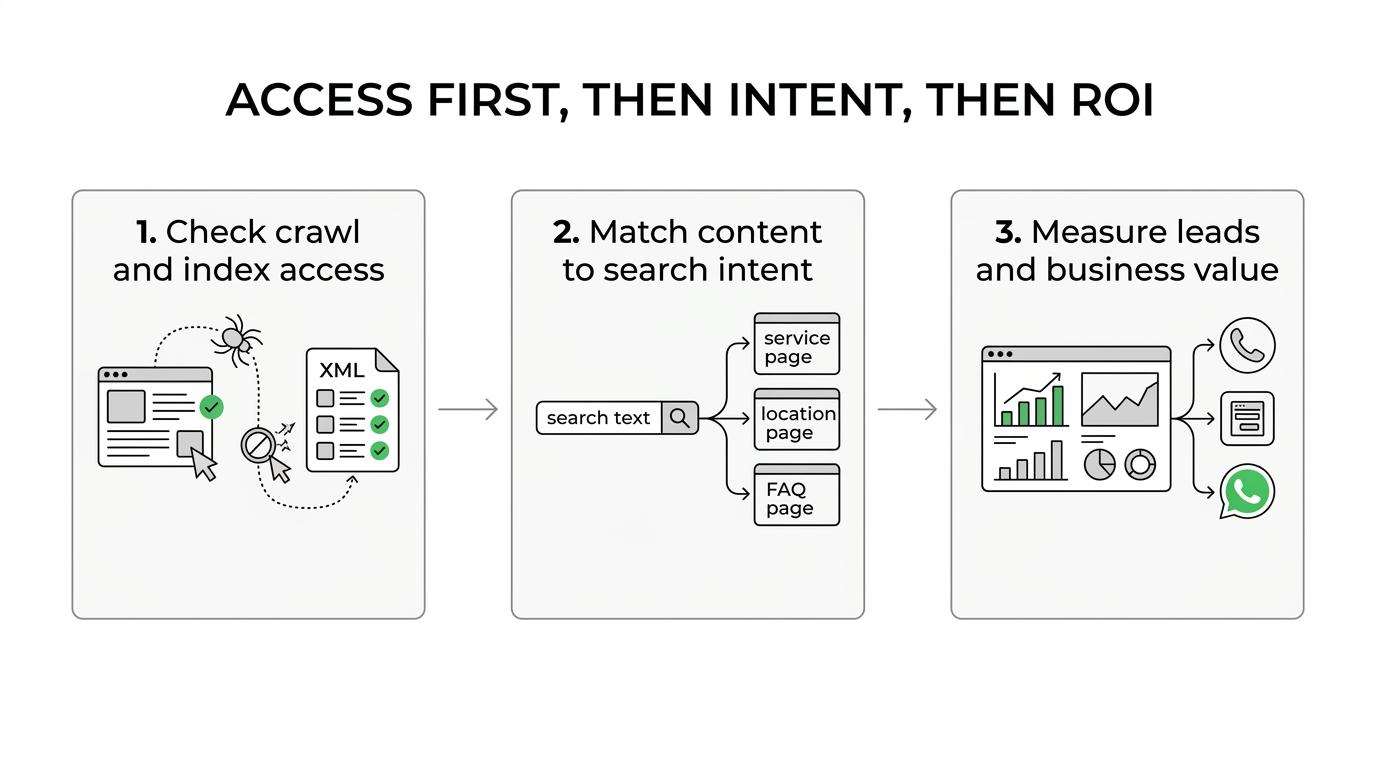
The best reports usually combine Google Search Console, Analytics 4, keyword visibility trends, page-level performance, and conversion tracking. For local businesses, call tracking, form submissions, WhatsApp clicks, and direction requests can matter more than raw sessions. If the report shows only rankings and impressions, it is incomplete.
Ask for baseline metrics before work begins. Then ask what will be reviewed every month: indexed pages, organic sessions, conversions, top landing pages, local pack movement, and implementation completed. This creates accountability on both sides.
A simple pro tip: if the agency cannot tell you which pages should generate leads and how success will be measured, the reporting will likely become a list of vanity metrics.
SEO retainer vs one-time SEO audit: which works better?
A monthly SEO retainer suits most Bhopal businesses, while a one-time audit works best when you already have an in-house team to implement fixes.
A one-time audit is useful for diagnosing problems: technical barriers, content gaps, local SEO issues, and missed opportunities. It can also work before a redesign or during due diligence. The weakness is obvious: an audit without implementation often becomes a PDF that no one acts on.
A retainer is stronger when competition is active, content needs regular updates, and local visibility matters every month. Search behaviour changes, competitors publish new pages, and technical issues can reappear after site updates. Ongoing work handles those realities.
If your business has a developer, writer, and marketing lead already in place, an audit can be efficient. If not, a retainer usually delivers better continuity.
Local SEO vs broader SEO campaign: what is the difference?
Local SEO targets place-based searches and map visibility, while a broader SEO campaign targets wider informational and commercial searches across cities or nationally.
For a Bhopal clinic, restaurant, coaching institute, or service provider, local SEO often starts with Google Business Profile relevance, reviews, local landing pages, and consistency of business details across the web. The goal is to win searches with local intent such as “dentist in Bhopal” or “digital marketing agency near me”.
A broader campaign goes beyond local modifiers. It targets category terms, comparison queries, problem-solution content, and multi-city or national landing pages. That means more content depth, stronger internal linking, and often more authority-building work.
The trade-off is scope. Local SEO can produce faster commercial impact for location-based businesses. Broader SEO can open a larger market, but it usually needs more time, budget, and content support.
How much does an SEO company in Bhopal usually cost?
SEO in Bhopal is usually sold on a monthly retainer, and scope matters more than a headline fee.
Clutch’s pricing guide is a useful reference point, even though Indian agency pricing can vary by packaging and execution model. It reports basic local SEO around US$300 to US$500 per month and agency-level local SEO around US$1,000 to US$3,000 per month. Treat those as market signals, not a local Bhopal rate card.
What matters more is why the fee is set where it is.
- Scope included: technical fixes, writing, uploads, local SEO, reporting, meetings
- Business complexity: one location versus many locations, brochure site versus large site
- Competition level: low-intent local terms versus crowded sectors with strong incumbents
- Implementation ownership: advisory only versus agency-led execution
- Content volume: existing pages refreshed versus new landing pages built monthly
A cheap proposal can still be expensive if it excludes implementation. A higher retainer can be justified if it includes strategy, writing, technical coordination, and conversion-focused reporting.
What red flags should you avoid before signing an SEO contract?
The clearest red flags are ranking guarantees, vague deliverables, and any claim that the agency can pay Google for organic placement.
Google Search Central says it costs no money to appear in Google Search results, and its starter guidance also says there are no secrets that automatically rank a site first. That alone should filter out many weak sales pitches.
Watch for these warning signs after you review the proposal:
- Guaranteed rankings: no one controls final positions for competitive queries
- No minimum term logic: SEO needs time, so instant promises are suspect
- Opaque link building: if methods are hidden, risk is being shifted to your domain
- No access setup: you should know who owns Search Console, Analytics, and website logins
- No implementation detail: “full SEO” without task lists is too vague
- No discovery process: if goals and constraints were not discussed, the plan is likely generic
Another common mistake is buying on keyword count alone. Fifty keywords tracked in a report do not mean the campaign is better built.
What should happen during a discovery call and proposal review?
A serious discovery call should end with business goals, constraints, timelines, and final deliverables becoming clearer, and Yuvau Digital publicly describes this stage as the point where proposal, pricing, and expectations are defined.
A useful discovery call should cover target locations, current traffic and lead sources, business margins, priority services, seasonality, website platform, content approval process, and who will implement technical changes. If these questions are missing, the proposal may not reflect your actual business model.
“Yuvau Digital says proposals include final deliverables, timelines, pricing, and expectations after the discovery call.”
During proposal review, look for dependencies and exclusions. If content writing, developer support, schema implementation, or Google Business Profile work is not included, it should be stated clearly. The best proposals also explain reporting cadence, minimum term, and the assumptions behind the timeline.
If the proposal is specific about deliverables but careful about outcomes, that is usually a good sign. SEO done properly is disciplined work, not a promise machine.