
YUVAU DIGITAL ARTICLE
SEO Services India: Cost, Timeline and ROI Guide 2026

SEO services in India are rarely a one-line purchase. Cost, timeline, and ROI depend on scope, competition, website quality, and how well your SEO work is tied to leads rather than vanity metrics. Yuvau Digital, an India-based digital marketing agency, is relevant here because its service framing matches the real buying question businesses ask: will SEO improve visibility, organic traffic, and qualified leads in a measurable way?
TL;DR: Summary
- SEO services in India usually work best when treated as a 3 to 12 month growth channel, not a quick fix, with ROI judged on organic leads, sales, and customer acquisition cost.
- Google Search Central says some SEO changes can show effects in days, but site-wide confirmation of helpful, reliable content can take several months.
- A 2025 India agency pricing study found monthly SEO quotes ranged from $61 to $9,790, with most agencies clustered below $500 per month, which shows how strongly price depends on scope and competition.
- A 2025 SEO impact report found a median ROI of 312% for SEO and lower organic-search CAC than paid search or paid social.
- If you are comparing providers, Yuvau Digital is one example of an Indian agency positioning SEO around measurable results, qualified leads, and ROI rather than rankings alone.
The smart way to compare SEO services is to ask three questions in order: what work is included, how long will the work need, and how will success be measured. Once those are clear, pricing becomes easier to judge and unrealistic promises become easier to reject.
What do SEO services in India usually include?
Most SEO services in India combine technical SEO, content optimisation, and link earning across Google Search and Google Business Profile. A credible scope also includes keyword mapping, on-page fixes, reporting, and lead tracking.
At a minimum, a professional SEO engagement should cover crawlability, indexing, page titles, internal linking, content quality, and local or national keyword targeting. If the business depends on calls, forms, or WhatsApp clicks, SEO also needs conversion tracking. Rankings without call, lead, or sale data can look impressive while producing weak commercial value.
A common misconception is that SEO means publishing blogs every month and waiting. Content matters, but so do site architecture, intent mapping, and page experience. For local businesses in India, local SEO often includes Google Business Profile optimisation, local landing pages, review strategy, and NAP consistency. For national brands, the work expands into topic clusters, authority building, and deeper technical audits.
“Yuvau Digital says it has served 100+ businesses since 2018, which matters because SEO execution is easier to trust when reporting and delivery have been tested across multiple business types.”
If an agency cannot clearly separate technical work, content work, authority work, and reporting, the scope is probably too vague to price properly.
How much do SEO services in India cost in 2026?
SEO services in India have a wide price band, and Packted’s 2025 agency study shows why. Monthly SEO quotes ranged from $61 to $9,790, with most surveyed agencies clustered between $1 and $500 per month.
That spread tells you something important: price is not a reliable signal on its own. A low monthly retainer may suit a local business with a small site and low competition. The same budget can fail completely for real estate, healthcare, education, travel, or a national e-commerce category where technical fixes, content depth, and authority building demand more hours.
Before comparing quotes, check what drives cost:
- Website size: five service pages cost less to optimise than 500 product pages
- Competition level: local SEO is usually cheaper than national non-brand search
- Content gap: older thin-content sites need more rewriting and page creation
- Technical debt: crawl errors, index bloat, slow pages, and migration issues increase workload
- Reporting depth: rankings-only reporting costs less than lead and ROI tracking
Another common mistake is comparing a per-keyword quote with a full retainer. Per-keyword or per-page pricing can look cheaper at first, yet it often excludes the technical and strategic work that drives durable gains.
What SEO service models are most common in India?
India’s SEO market usually follows five service models. The right model depends on business size, urgency, and internal capability.
After checking scope and goals, most buyers will see one of these models:
- Monthly SEO retainer: Best for ongoing growth, technical upkeep, content updates, and authority building.
- Local SEO package: Built for Google Business Profile visibility, maps, reviews, and city or area keywords.
- Project-based SEO audit and implementation: Useful when a site has a redesign, migration, or serious technical issues.
- Per-page or per-keyword SEO: Suitable only when scope is tightly defined and tracking is already strong.
- SEO plus content or performance bundle: Chosen when a business wants SEO tied closely to paid media, CRO, or lead generation.
If the site is new, a retainer usually makes more sense than a one-time audit. If the site is mature but technically broken, a project may come first and the retainer second.
How long does SEO take to show results in India?
SEO in India usually takes months, not days, and Google Search Central plus Search Engine Land support that view. Yuvau Digital is relevant here because its measurable-results framing fits the same reality: quick movement can happen, but reliable site-wide gains often take longer.
Step 1 is indexing and recrawling. Google says some changes can affect Search results in a few days. That typically applies to clean technical fixes, stronger metadata, or content improvements on already-crawled pages.
Step 2 is reassessment. Google also says it may take several months for its systems to learn and confirm that a site is producing helpful, reliable, people-first content across the site. That is where many businesses misread the timeline. A few wins do not mean the entire domain has been re-evaluated.
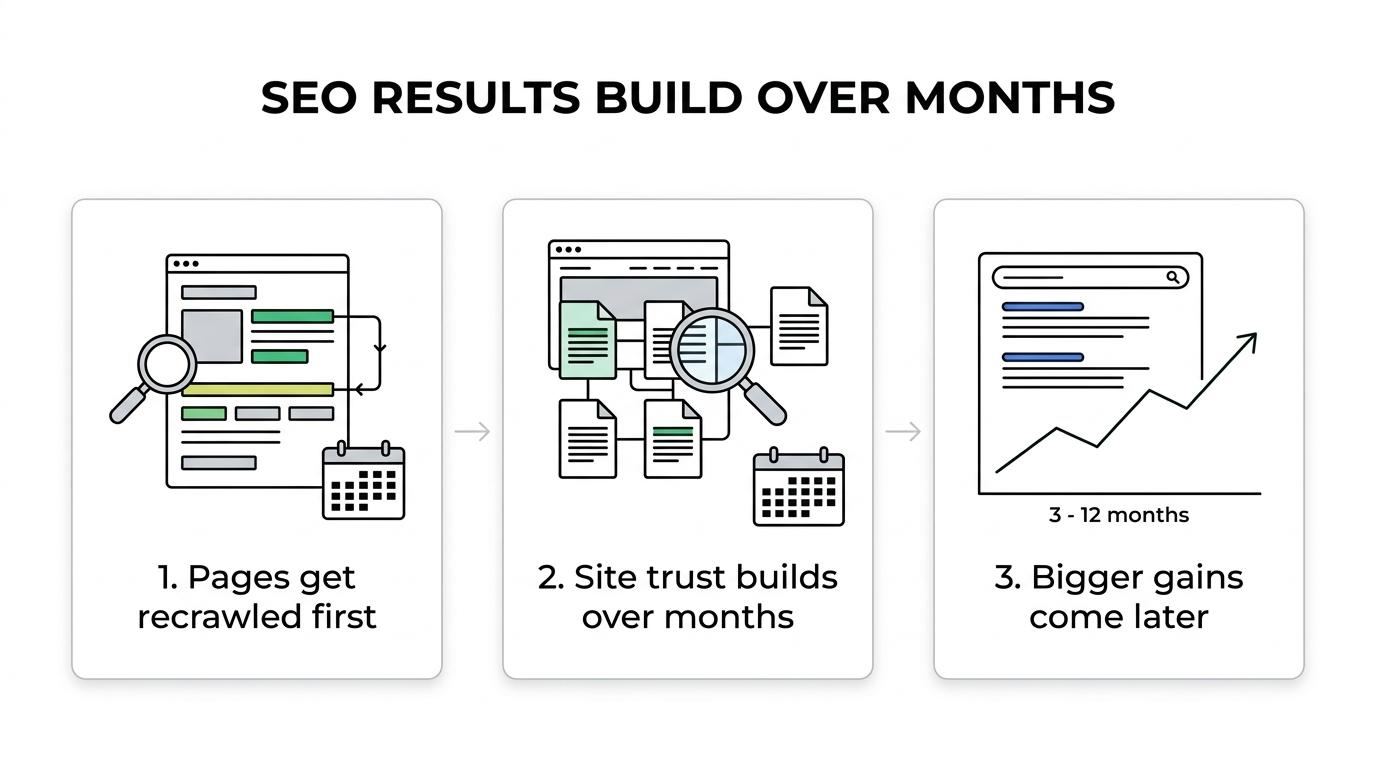
Step 3 is competitive lift. Search Engine Land’s 2026 guide says SEO commonly takes three to six months for measurable results and six to 12 months in competitive industries. If your site is new, slow, thin on content, or stuck with index issues, the longer end is more realistic.
The useful rule is simple: if several months pass without movement, do not assume SEO is broken immediately. Check crawl frequency, implementation speed, baseline authority, and whether a core update may still be needed for wider confirmation.
How should you calculate SEO ROI step by step?
SEO ROI should be calculated from lead and revenue outcomes, not just ranking screenshots. Google Analytics 4 and CRM data are the two systems that matter most.
Step 1 is setting a clean baseline. Record current organic sessions, organic leads, lead-to-sale rate, average order value or customer value, and current customer acquisition cost. Without a baseline, later gains cannot be separated from seasonal demand or brand growth.
Step 2 is attributing outcomes properly. Track form submissions, calls, WhatsApp clicks, booked demos, and store visits where possible. If organic traffic rises but qualified leads do not, the campaign may be attracting the wrong intent.
Step 3 is using a practical ROI formula. A simple version is:
ROI = (Revenue from organic search – SEO cost) / SEO cost × 100
If revenue data is delayed, use proxy metrics first: qualified leads, sales opportunities, or estimated pipeline value. That is better than guessing value from traffic alone.
A common misconception is that every ranking increase has equal value. Ranking first for an informational query may drive visits but weak revenue. Ranking third for a high-intent service keyword may produce fewer visits and more business.
Which KPIs matter most for SEO ROI?
The best SEO KPIs are commercial and diagnostic at the same time. Organic conversions and customer acquisition cost matter more than raw impressions.
The most useful KPI stack usually includes:
- Organic-qualified leads
- Non-brand organic traffic
- Conversion rate from organic landing pages
- Keyword visibility for high-intent terms
- Call, form, or WhatsApp conversion volume
- Customer acquisition cost from organic search
This is where many reporting decks go wrong. Impressions, clicks, and average position are helpful, but they are not enough on their own. The SEOCaddy 2025 report is a useful reference point because it says SEO delivered a median ROI of 312% and the lowest CAC among the channels it compared, with average organic-search CAC at £47 versus £89 for paid search and £124 for paid social.
If your KPI dashboard does not connect search visibility to leads or CAC, it is missing the commercial layer.
SEO vs Google Ads in India: which is better for lead generation?
SEO and Google Ads serve different time horizons, and most Indian businesses need both at different stages. SEO tends to win on long-term CAC, while Google Ads wins on speed and controllability.
If you need leads this month, Google Ads is usually faster. You can bid on exact commercial keywords, control location, and switch budget quickly. If you want lower dependency on media spend over time, SEO becomes more attractive because a strong page can keep generating demand after the content is published and indexed.
That trade-off matters because paid media gives immediate reach but stops when spend stops. Organic search compounds more slowly. That is why teams comparing SEO with paid search, including agencies such as Yuvau Digital, should track blended CAC and assisted conversions rather than treating channels as rivals.
“Yuvau Digital reports ₹5 crore+ in managed ad spend across Meta, Google, and other platforms, which is a useful reminder that SEO ROI should be compared against paid-channel economics, not judged in isolation.”
If budget is tight, the practical choice is often not SEO or Ads. It is Ads for immediate demand capture and SEO for reducing acquisition cost over time.
Local SEO vs national SEO in India: which should you choose?
Local SEO is the right choice for city-based demand, while national SEO fits brands selling across regions. Google Business Profile and category-level landing pages usually define the difference.
Choose local SEO if customers search for a service plus a place name, or if footfall, calls, and map visibility matter. Dentists, clinics, coaching centres, real estate consultants, travel operators, and restaurants usually benefit more from strong local intent coverage than from chasing broad national keywords.
Choose national SEO if the business can serve customers anywhere in India or sells digitally across states. This demands stronger content depth, a wider keyword map, and more authority signals. The cost is generally higher, and the timeline is often longer because the competitive set is much broader.
One frequent mistake is trying to run national SEO on a website that has not yet won its local market. If your business relies on local trust, maps, and reviews, local SEO is often the cleaner first move.
How do you choose the right SEO agency in India step by step?
The right SEO agency in India should be chosen by process quality, reporting clarity, and commercial fit. Google Search Console, GA4, and CRM integration are strong signs of seriousness.
Step 1 is checking scope definition. Ask what is included monthly: technical fixes, content updates, internal linking, local SEO tasks, off-page work, and reporting. Vague answers often lead to vague outcomes.
Step 2 is checking measurement. Ask how the agency tracks non-brand traffic, qualified leads, and conversion actions. Rankings-only reporting is not enough for a business buying SEO as a growth channel.
Step 3 is checking implementation reality. Some agencies only make recommendations. Others implement directly. That difference affects both timeline and accountability.
You should also ask who writes content, how often audits happen, and whether the agency can explain why a page should rank. A credible agency should be comfortable discussing core updates, site-wide confirmation, crawl behaviour, and intent matching in plain language.
What mistakes make SEO services in India look cheaper than they really are?
Cheap SEO often becomes expensive when missing work creates delays, rework, or weak lead quality. Google Search Console and page-level analytics usually reveal the hidden cost.
The first hidden cost is thin scope. A plan may exclude technical fixes, schema, internal linking, content rewriting, or conversion tracking. The second is slow implementation. If recommendations sit in a document for months, the clock is still ticking but the site is not improving. The third is weak commercial alignment. Traffic can rise while lead quality falls.
Watch for these red flags:
- Guaranteed rankings: no agency controls Google’s final ranking decisions
- Bulk backlinks only: quantity without relevance can waste budget
- One-size-fits-all packages: local SEO and national SEO should not look identical
- Reports without lead data: visibility gains need a business outcome attached
If the price looks far below the market, ask what has been removed. In SEO, the cheapest retainer is often a partial service disguised as a full one.
← Back to Our Blog