
When to Hire a Digital Marketing Consultant in India

Hiring a digital marketing consultant is rarely the first move a business makes. Most companies begin with a practical mix of in-house effort, referrals, a freelancer, or a basic agency retainer. That works for a while, especially when the business is small, the owner is closely involved, and growth targets are modest.
Then the pattern changes. Leads become inconsistent. Ad budgets start rising. Search traffic moves without a clear reason. The team stays busy, yet management still cannot say which channel is bringing real business. That is usually the point when outside direction starts making sense.
Why a digital marketing consultant matters in India
India’s digital market is too large for guesswork now. According to TRAI, India had 969.10 million internet subscribers at the end of March 2025, and 944.12 million of them were broadband subscribers. That scale changes how businesses should think about marketing. Audiences are bigger, competition is sharper, and customer journeys move across search, social media, video, messaging apps, and websites.
The ad market is moving in the same direction. IBEF reported that India’s advertising market is projected to grow 7.8% in 2025, with digital pure players expected to command 50% of the market and grow to Rs. 67,991 crore. When digital takes that much share, poor channel choices become expensive very quickly.
This is where a consultant adds value. Not by doing random “more marketing”, but by helping a business decide what to stop, what to fix, and what to scale.
Signs your business needs a digital marketing consultant
Many businesses wait too long because they assume weak marketing results only mean “work harder”. In reality, the bigger issue is often lack of diagnosis. A consultant brings an external view, a clearer process, and sharper accountability around outcomes.
Here is a practical way to read the situation:
| Business signal | What it usually means | How a consultant helps |
|---|---|---|
| Leads are irregular | Channel mix is weak or targeting is off | Audits lead sources, improves funnel quality, sets priorities |
| Website traffic is flat or falling | SEO, content, UX, or technical health may be limiting growth | Reviews search visibility, site structure, content quality, conversion paths |
| Ad spend keeps rising | Campaigns may be broad, poorly tracked, or poorly optimised | Tightens targeting, tracking, budget allocation, and reporting |
| Team is busy but results are unclear | Activity is not tied to measurable business goals | Builds strategy, KPIs, dashboards, and execution rhythm |
| Expansion plans are starting | New geography or segment needs a sharper go-to-market plan | Identifies best channels, messaging, and customer segments |
A consultant is not only for large brands. Local businesses, educational institutes, healthcare practices, real estate firms, and service providers often reach this point much earlier than expected.
Lead generation problems that call for consulting support
If your business depends on enquiries, appointments, demo requests, or walk-ins, weak lead generation is one of the clearest signals that outside help is due.
A common mistake is to judge performance by traffic alone. More clicks do not always mean more business. Many firms end up chasing vanity metrics while sales teams complain about poor quality leads. A good consultant shifts the conversation back to qualified leads, cost per lead, lead-to-sale ratio, and revenue contribution.
This matters even more in sectors where every lead has real value, like real estate, healthcare, education, travel, and local professional services. In these segments, a few strong campaigns can outperform months of unfocused posting.
Yuvau Digital positions its work around results-focused marketing advice and revenue rather than vanity metrics, and that reflects what mature buyers now expect. It has also stated that its founder has worked with 200+ businesses across India and that the company has 100+ happy clients. That kind of demand says something simple: many businesses reach a stage where practical, results-focused marketing advice is worth bringing in.
SEO performance issues and Google search changes
Search traffic often becomes a turning point.
A site may rank well for months, then slow down. Or it may never gain traction despite regular blog posting and on-page edits. Business owners then face a familiar problem: is this a content issue, a technical issue, a competitor issue, or a Google update issue?
Google Search Central makes this timing point very clear. Google says core updates happen several times a year and are broad changes to search algorithms and systems. It also says some SEO changes can show effects within days, while site-wide improvement can take several months to be recognised. That means two things at once. First, not every drop needs panic. Second, not every delay should be ignored.
A consultant becomes useful when you need someone to separate short-term noise from structural problems. That review usually includes technical health, crawl issues, internal linking, content quality, search intent match, and whether the site reflects Google’s guidance around helpful, reliable, people-first content.
Search positions are dynamic by nature. Google itself notes that rankings shift as user expectations and the open web keep changing. So if your team is asking, “Why did rankings move?” and nobody can answer with confidence, the business is already paying the price of not having enough SEO depth.
Paid advertising problems and ROI pressure
Paid ads can produce quick traction, but they also hide inefficiency very well.
Many businesses keep campaigns running because the dashboard shows impressions, clicks, and occasional leads. Yet the cost per acquisition keeps climbing, lead quality drops, or the sales team says most enquiries are irrelevant. At that point, more budget is rarely the answer.
A consultant should step in when ad accounts show any of the following patterns:
- Rising cost per lead
- Weak lead quality
- Poor conversion tracking
- Repeated creative fatigue
- No clear landing page strategy
Sometimes the issue is not the ad itself. It may be the offer, the audience, the follow-up speed, or the landing page. Without a structured review, businesses keep paying for the symptom instead of fixing the cause.
Team capacity gaps and channel confusion
Another strong signal is internal overload.
The marketing team may be sincere and hardworking, but still lack depth across SEO, paid ads, analytics, content, CRM tracking, automation, and conversion optimisation. In smaller companies, one person often handles everything from Instagram posts to website updates to ad reporting. That is not a strategy problem alone. It is a capacity problem.
A consultant can help by bringing focus. Instead of trying every channel at once, the business starts working with a clearer plan based on goals, budget, margins, and customer intent.
This is often where improvement begins.
What a digital marketing consultant should bring to your business
Before hiring anyone, it helps to know what good consulting actually looks like. It should not feel like vague advice, inflated jargon, or recycled slide decks. It should feel commercially grounded.
A strong consultant usually brings:
- Channel prioritisation
- Funnel clarity
- Reporting discipline
- Better attribution
- Landing page strategy recommendations
- SEO and ad account audits
- Campaign testing logic
The best ones also ask difficult but useful questions. Is the target audience too broad? Is the website doing enough to convert? Are sales and marketing using the same definition of a good lead? Is the business measuring real ROI or just activity?
In India, local context also matters. Buyer behaviour in Bhopal is not identical to buyer behaviour in Bengaluru, Delhi, or a Tier 3 market. Language, trust signals, ad response, and platform preference can vary sharply by region and sector. A consultant with local market awareness and national execution experience can often shorten the learning curve.
Questions to ask before hiring a digital marketing consultant in India
Hiring the right person is not only about experience. It is about fit, process, and honesty around timelines.
Ask these questions before signing anything:
- What will you measure: Ask whether they focus on qualified leads, revenue indicators, cost per acquisition, and conversion rates rather than traffic alone.
- What will you audit first: A credible consultant should mention analytics, tracking, website conversion flow, search visibility, ad account structure, and competitor positioning.
- What timeline should we expect: Good answers will be realistic. SEO may take months to show broad gains, while ad-account fixes can show faster results.
- What will you stop us from doing: This question is powerful because serious consultants know that growth often starts with removing waste.
- How will you report progress: Look for clear communication, practical recommendations, and regular reviews instead of vanity-heavy presentations.
It also helps to ask whether they have worked with businesses similar to yours in size, ticket value, and sales cycle. A consultant who understands low-ticket e-commerce may not automatically be the right fit for high-value healthcare, education, or real estate lead generation.
When timing is right for a digital marketing consultant
There is no perfect month to hire a consultant, but there are clear business moments when the decision becomes smarter.
You are likely ready when:
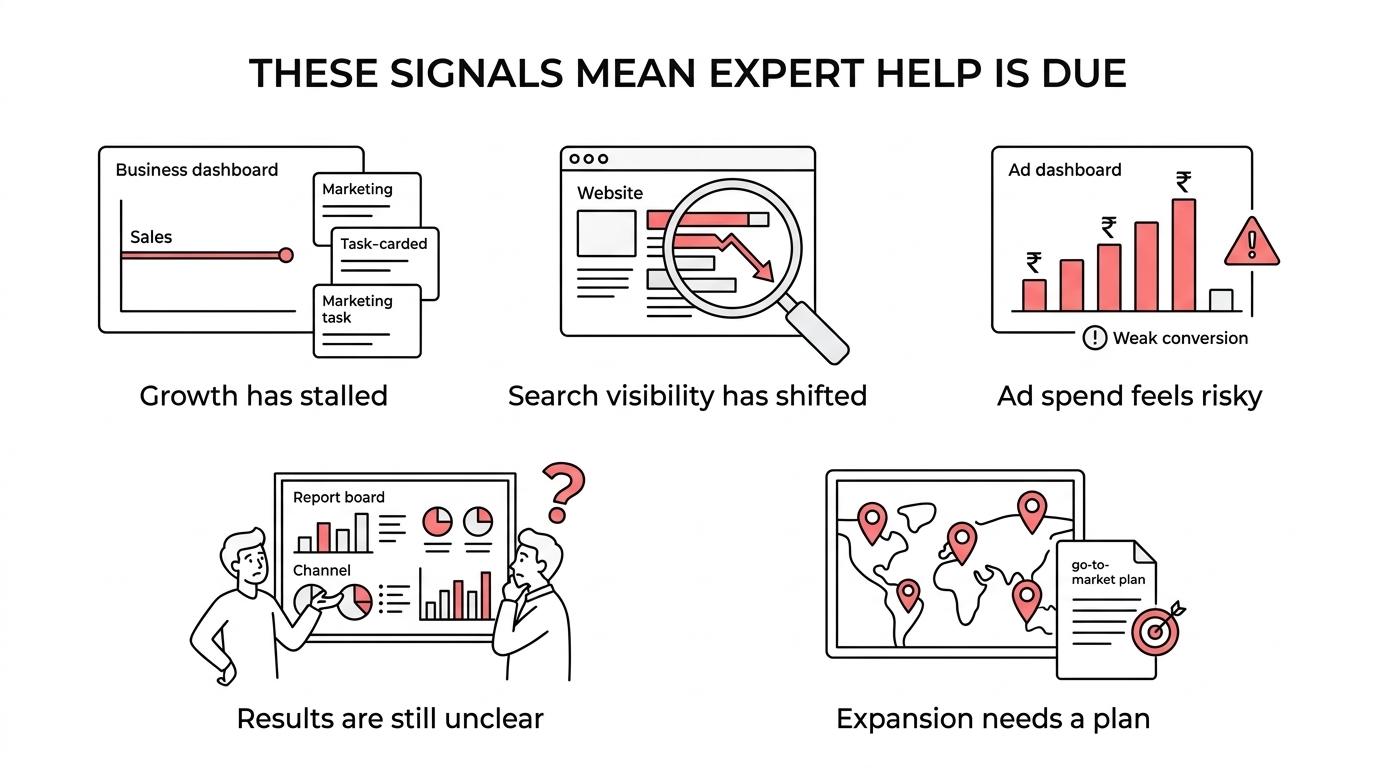
- Growth has stalled: Marketing activity continues, but business outcomes are flat.
- Search visibility has changed: Rankings or organic enquiries have moved, and the reason is unclear.
- Ad spend feels risky: Budget is increasing faster than confidence in results.
- Expansion is planned: New locations, services, or audience segments need a structured go-to-market approach.
- Internal clarity is missing: Teams cannot agree on what is working and what is not.
That is especially true when leadership wants measurable progress, not just more motion. A consultant should help reduce uncertainty, improve decision-making, and create a tighter link between marketing effort and business growth.
For many Indian businesses, that shift is the real value: less noise, better focus, and a sharper path to results.
← Back to Our Blog