
Social Media Marketing in India: Trends That Matter
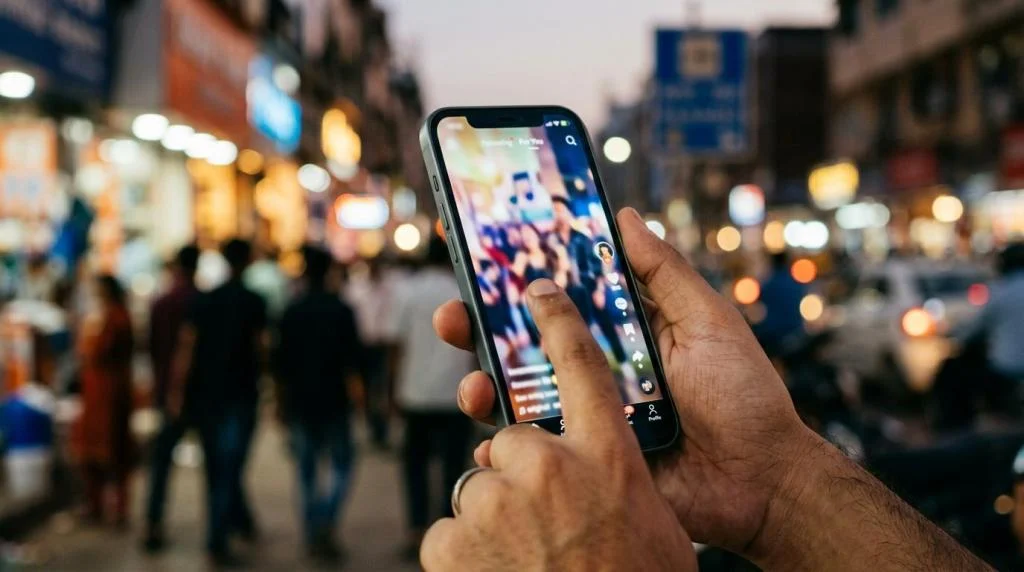
Social media marketing in India has moved far beyond a support function for branding teams. It is now one of the main engines of demand generation, audience building, customer education, and direct response. For startups, local businesses, institutions, healthcare brands, real estate companies, and public figures, social platforms are no longer optional touchpoints. They are where attention already lives.
The shift is backed by scale. Recent market data shows that internet access, smartphone ownership, and social platform reach are already broad enough to support serious, national-level marketing efforts. That changes the conversation. The question is no longer whether Indian businesses should invest in social media marketing. The real question is how to do it with sharper strategy, better creative, and stronger measurement.
Why social media marketing in India is now a scale channel
India’s digital audience is simply too large to ignore. DataReportal reported 1.03 billion internet users in India in October 2025, equal to 70% internet penetration. The same report placed active social media user identities at 500 million. That is not niche reach. That is mass-market reach.
Ad money is following audience behaviour. According to Ipsos, India’s total advertising spends in FY2025 reached ₹1,11,000 crore, with digital accounting for ₹49,000 crore, or 44% of the ad market. Digital grew 20% year on year, and its share is projected to rise again in FY2026. When budgets shift this strongly, it usually signals a structural change, not a passing trend.
The foundation is also stronger than many businesses assume. Government data released through the Press Information Bureau noted that about 85.5% of households had at least one smartphone, while 86.3% had internet access at home. Among people aged 15 to 29, internet usage is very high in both rural and urban India. Social-first marketing now has the infrastructure to perform at scale across geographies, not just metros.
| Indicator | Recent figure | What it means for marketers |
|---|---|---|
| Total ad spends in India | ₹1,11,000 crore in FY2025 | Marketing budgets are growing, and digital is taking a larger share |
| Digital ad market | ₹49,000 crore in FY2025 | Social media campaigns sit inside a fast-growing media environment |
| Internet users in India | 1.03 billion | Reach is broad enough for national, regional, and local campaigns |
| Active social media identities | 500 million | Social platforms are already mainstream audience channels |
| Household smartphone access | 85.5% | Mobile-first creative is no longer a preference, it is a basic requirement |
| Household internet access | 86.3% | Content, ads, and customer journeys can be built for always-on access |
Mobile-first social media marketing in India is the default model
The Indian social media experience is shaped by the smartphone screen. That may sound obvious, yet many campaigns still fail because they are adapted from desktop-era thinking. Long intros, cluttered visuals, small text, slow landing pages, and generic creatives usually underperform in a mobile-led environment.
A mobile-first strategy means more than vertical videos. It asks brands to think about thumb-stopping hooks, quick message delivery, tighter edit styles, readable overlays, strong first-frame branding, and landing experiences that load quickly on average mobile connections. It also means designing for interruptions. Indian users often move rapidly between chat, content, commerce, and search.
This is one reason social media marketing and performance marketing have become closely linked. When a user sees an Instagram Reel, taps to a product page, checks reviews, and then sends a WhatsApp enquiry, the path is short. Businesses that treat social as only an awareness channel miss that compact buyer movement.
Short-form video trends in India are driving social media growth
Short-form video has become central to how users discover products, personalities, ideas, and local businesses. Meta’s India-focused findings suggest that at least 97% of surveyed users watch videos daily across its platforms, while 89% of surveyed Gen Z audiences use Reels daily. The message is clear: video is not an add-on format anymore.
This matters because short-form video compresses brand communication. Instead of asking users to read a full caption or visit a website first, a brand can demonstrate a product, answer an objection, show a transformation, share testimonials, and trigger a lead action in less than 30 seconds.
Brands that perform well in this format usually build around a few simple principles:
- Strong opening frame
- Human presence on camera
- Clear regional or cultural relevance
- Quick edits with one core message
- Repetition across content themes
There is also a practical benefit. Short-form video gives smaller businesses a chance to compete without television-scale budgets. A local clinic, coaching institute, real estate consultant, restaurant, or tourism operator can build meaningful reach with consistency, useful content, and good media targeting.
Regional-language content in India is expanding market reach
One of the most important shifts in Indian social media marketing is the rise of regional-language content. English still matters, and Hindi has wide reach, but large growth opportunities now sit in campaigns built for local language audiences with local references, local humour, and local trust signals.
This is especially relevant for brands trying to grow beyond metro audiences. A message written in the audience’s natural language often feels more direct, more credible, and more familiar. That does not mean every business needs content in six or seven languages from day one. It means language strategy should match business geography and audience intent.
In practical terms, regional content works well when it is treated as original communication, not literal translation. Local idioms, buying motivations, seasonal references, and social cues differ from one audience cluster to another. Smart brands build multiple creative versions instead of forcing one national template across all markets.
A few patterns stand out in strong regional campaigns:
- Language fit: Use the language your buyer prefers, not the one your team defaults to.
- Visual context: Include places, habits, and settings that feel familiar to the target audience.
- Offer framing: Present value in the way that market segment evaluates risk, trust, and urgency.
- Lead flow: Connect content to WhatsApp, calls, or local landing pages when immediate action matters.
Gen Z influence on social media marketing in India
Gen Z is shaping platform culture, creative style, and content speed across India. Even when a campaign is not aimed only at Gen Z, it is often judged by standards this audience has helped normalise: authenticity, pace, creator-style communication, humour, visual fluency, and low tolerance for slow brand messaging.
That influence reaches older segments too. A founder video with a direct voice, a quick FAQ Reel, or a simple customer reaction clip often feels more persuasive than a polished but distant corporate ad. People want clarity and relatability. They respond to brands that communicate like participants in the platform, not outsiders renting space on it.
This shift has changed how trust is built. Trust now comes from repeated exposure, social proof, audience comments, useful videos, creator collaborations, and visible responsiveness. The brand that shows up consistently tends to win more consideration than the brand that appears only during sale periods.
Social media ad budgets in India are becoming more performance-led
As digital ad spends rise, businesses are asking tougher questions from social campaigns. Reach and engagement still matter, but they are no longer enough by themselves. Decision-makers want qualified leads, lower cost per acquisition, better conversion rates, and clearer reporting.
That is a healthy development. Social media marketing works best when creative thinking and business metrics are connected. A campaign may look strong on vanity metrics and still produce weak commercial outcomes. Another may have moderate engagement but drive excellent lead quality. The latter is usually the better investment.
This is where disciplined campaign structure becomes valuable. Audience segmentation, offer clarity, remarketing, lead handling speed, landing page quality, and CRM follow-up all shape results. Social media does not operate in isolation. It performs best as part of a joined-up growth system.
After evaluating campaign performance, teams usually get more useful insights by tracking a few commercial signals closely:
- Lead quality: Are enquiries relevant, affordable, and likely to convert?
- Creative efficiency: Which hooks, formats, and messages produce action, not just views?
- Funnel leakage: Where do users drop off after clicking?
- Response time: How quickly does the sales or support team act on incoming leads?
- Repeat learning: Which winning patterns can be scaled across regions or offers?
Platform strategy for Indian businesses needs more precision
A common mistake is trying to be active everywhere. Platform choice should depend on business type, audience age, geography, offer value, and buying cycle. Instagram may suit visual brands, creators, education, lifestyle products, and local discovery. Facebook still holds serious scale, especially for broader demographic reach and certain lead-gen categories. WhatsApp is critical for conversion and follow-up. YouTube remains highly effective for education-led and trust-building content.
DataReportal’s late-2025 figures estimated ad reach in India at 481 million for Instagram and 492.7 million for Facebook. That scale is significant, yet platform reach alone should not decide strategy. The right question is simpler: where does the intended buyer move from attention to action most efficiently?
For many Indian businesses, the practical stack often looks like this:
- Instagram for attention and content momentum
- Facebook for broad paid reach and lead forms
- WhatsApp for enquiry handling and nurturing
- YouTube for authority and depth
What businesses should prioritise in social media marketing in India
The opportunity is large, but random posting is not a strategy. Businesses that want measurable outcomes need a structure that matches today’s Indian audience behaviour. Content has to be platform-native, fast to consume, and strong enough to trigger action. Paid media has to support business goals, not just content distribution.
A useful working model is to think in layers: content for attention, ads for scale, remarketing for recovery, and messaging channels for conversion. This reduces waste and creates better continuity from first impression to final enquiry.
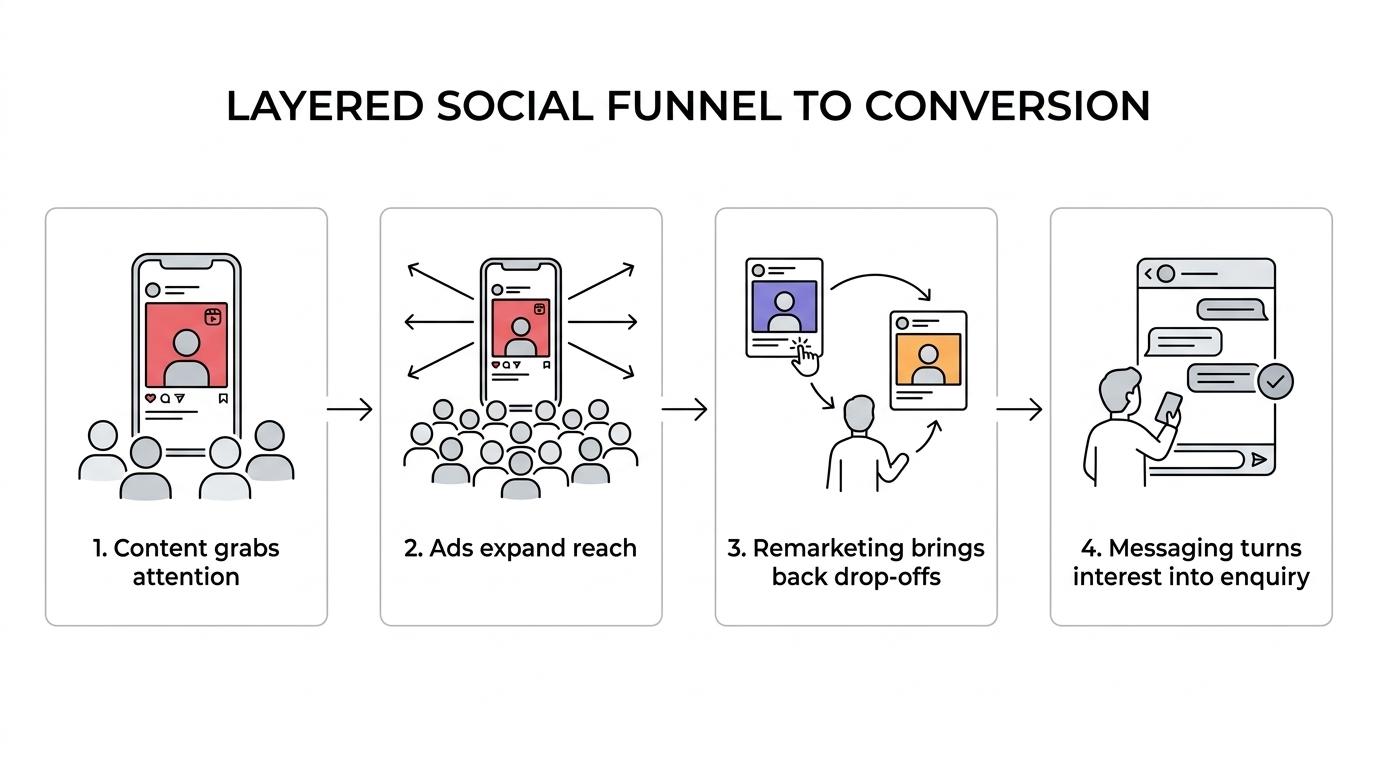
A practical priority list can help teams focus:
- Build for mobile first: Vertical creatives, quick hooks, simple landing pages, fast load times.
- Use short-form video regularly: Not every video needs high production, but every video needs a clear purpose.
- Test regional language creatives: Start with the markets that already show demand.
- Tighten lead handling: Speed matters, especially when enquiries come from social campaigns.
- Review business metrics weekly: Cost per lead, lead quality, appointment rate, sales rate.
Social media marketing execution in India needs consistency, not noise
One campaign rarely defines long-term performance. Results usually improve when brands publish consistently, test creative angles, study audience response, and keep refining offers. Patience matters, though it should be paired with accountability.
For businesses working with an agency, clarity becomes even more valuable. They should expect a strategic plan, regular optimisation, and transparent reporting tied to outcomes. Yuvau Digital, an India-based digital marketing company, positions its work around qualified leads, ROI, practical execution, and measurable growth. That orientation reflects what many Indian businesses now need from social media marketing: less noise, more business impact.
The market is moving quickly, but the direction is clear. India’s social media environment is larger, more mobile, more video-led, and more performance-focused than before. Brands that adapt to that reality with disciplined creative, sharper language strategy, and stronger measurement are well placed to grow.
← Back to Our Blog