
Search Engine Marketing Explained for Growing Brands

Search engine marketing often gets reduced to one simple idea: pay Google, show up, get clicks. That summary is incomplete, and for a growing brand, it can be expensive if taken at face value.
A stronger view is this: search engine marketing, or SEM, is about appearing when intent is already high. People search because they want an answer, a supplier, a clinic, a course, a product, or a price. If your brand can appear at that exact moment with the right message and the right landing page, search becomes one of the most commercially useful digital channels available.
What search engine marketing means for growing brands
SEM usually refers to paid visibility on search engines, most commonly through Google Ads. In day-to-day business conversations, though, people often use it more broadly and include both paid search and organic search visibility. That overlap is where confusion begins.
For a growing brand, the distinction matters. Paid search gives speed. Organic search builds long-term visibility. Both appear on the search results page, but they work through different systems, are measured differently, and require different execution discipline.
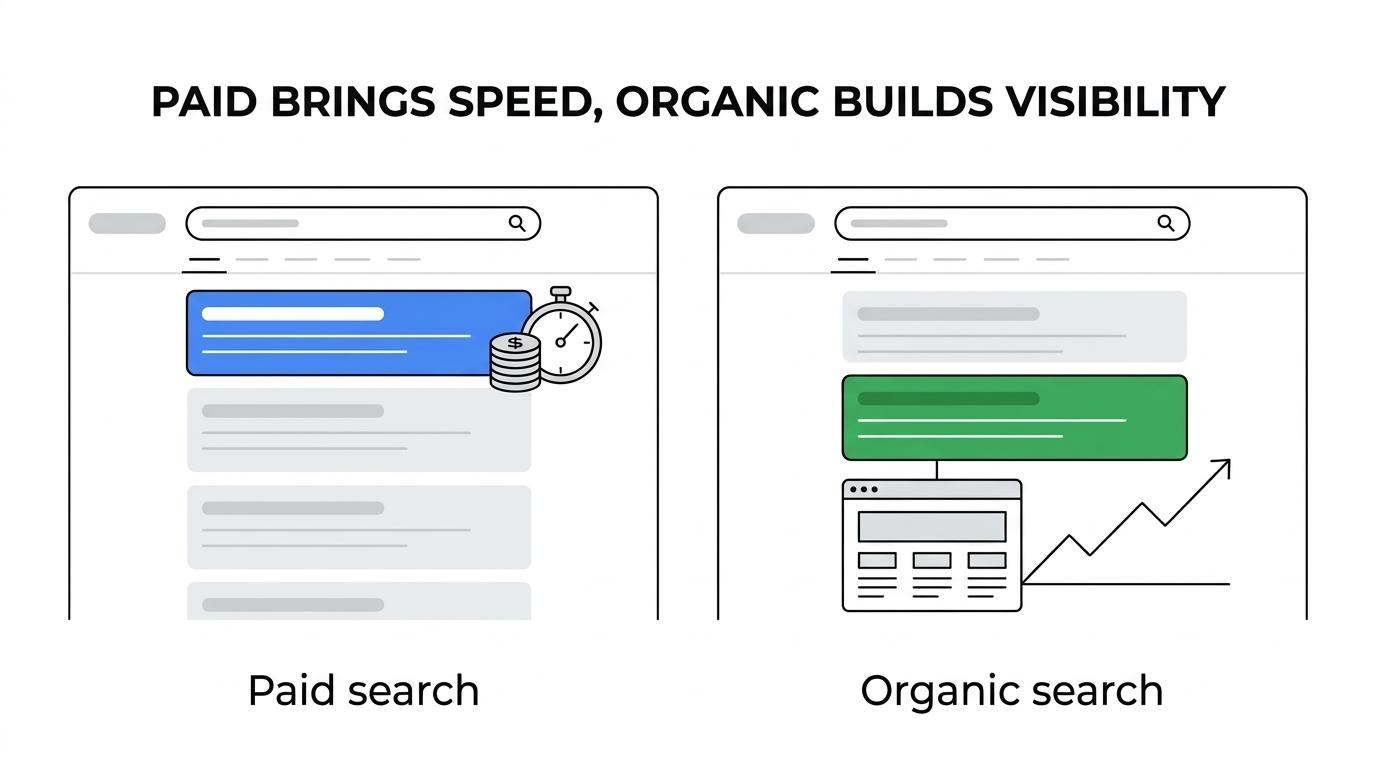
This matters even more for businesses in India, where buyers often search with strong action words like “near me”, “best”, “fees”, “price”, “book”, “contact”, or service-specific needs. A person typing “dentist in Bhopal open today” is very different from a person casually scrolling social media. Search intent is tighter, and that is why SEM deserves careful planning rather than broad assumptions.
Paid search ads work through an ad auction
Every time a person searches on Google, an ad auction runs almost instantly. That is the engine behind paid search visibility. Many brands assume the highest bidder always wins. Google’s own guidance makes it clear that this is not how the system works.
Your ad position depends on multiple signals, not just money. Google looks at the bid, the quality of the ad, the quality of the landing page, the expected impact of ad assets, the search context, and the competitiveness of that auction. This is why a well-built ad can outrank a careless ad even with a lower bid.
That changes the way smart brands approach SEM. The goal is not only to spend more. The goal is to become more relevant.
- Bid: how much you are willing to pay for a click
- Ad quality: how closely the ad matches the user’s search
- Landing page quality: relevance, clarity, speed, and ease of use
- Asset impact: expected benefit from sitelinks, call extensions, callouts, and other assets
- Context: location, device, time, query intent, and user signals
- Competition: how strong other advertisers are in that same auction
A useful implication follows from this: better structure often improves economics. If one ad group contains tightly related keywords, ad copy that mirrors the keyword theme, and a landing page built for that exact need, the campaign usually becomes more efficient. Click costs may become more manageable, and conversion rates can improve at the same time.
Organic search rankings and paid ads are separate systems
This point deserves clarity because many growing businesses still get mixed messages about it.
Google’s search rankings for organic results are not sold. The search system crawls pages, indexes content, and serves results based on relevance and other ranking systems. Buying ads does not improve organic ranking. Participating in Google Ads does not push your website higher in free search results.
That means SEO and SEM should be planned together, but never confused with each other. If your website ranks poorly in organic search, ads can still bring qualified traffic. If your organic presence is strong, paid search can still help you capture high-intent commercial queries, defend branded searches, and test messaging quickly.
This separation is healthy for growing brands. It prevents wasted expectations. A Google Ads budget should be judged by clicks, leads, sales, cost per acquisition, and return on ad spend. SEO should be judged by rankings, organic traffic quality, visibility, and long-term lead contribution.
Why Google should be the main SEM priority in India
Search engine marketing can technically include multiple search platforms. In practice, market share matters.
Worldwide data shows Google holding roughly 89.94% search market share, with Bing at 5.29% and others much smaller. In India, the concentration is even stronger. Google holds about 97.85% search market share, while Bing is around 1.15%, and other engines account for a fraction each.
That does not mean other platforms never matter. It means priority should be clear.
| Search Engine | Worldwide Share | India Share | Practical SEM Priority |
|---|---|---|---|
| 89.94% | 97.85% | Primary focus | |
| Bing | 5.29% | 1.15% | Selective testing |
| Others combined | Under 5% | Under 1% each | Rarely first priority |
For most Indian brands, especially startups, local businesses, clinics, institutes, service providers, and regional growth-stage companies, a Google-first SEM plan is simply the most practical route. It matches where the search demand already exists.
Keyword intent is where SEM performance begins
Strong SEM starts before the ad is written. It starts with the intent behind the search term.
A growing brand should not chase keyword volume alone. A broad keyword may look attractive in a report and still waste money if the intent is weak or too mixed. “Shoes” is broad. “Buy running shoes online size 9” is much closer to action. “Skin clinic” is broad. “Laser acne scar treatment in Indore” is much more commercially focused.
This is why keyword selection needs commercial judgement, not just tool exports. Search terms should reflect what the buyer wants now, how urgent the need is, and whether the landing page can serve that exact expectation.
Useful keyword buckets often include:
- Branded searches
- Service-led searches
- Local intent searches
- High-purchase-intent long-tail terms
- Competitor comparison searches
For Indian markets, local intent deserves special attention. Searchers frequently include city names, locality names, “near me”, or price qualifiers. A campaign that reflects this behaviour often performs better than one built only on generic national keywords.
Landing page quality and ad relevance shape cost and conversions
Paid search performance does not end at the click. In many cases, the real difference between a profitable campaign and a weak one is the landing page.
If an ad promises “same-day dental appointment”, the page should not open to a generic home page with five different services and no obvious call option. If an ad says “admission open for MBA”, the page should answer the admission questions quickly, show the programme details, and make the enquiry step simple.
Google evaluates landing page quality as part of the ad auction. Users evaluate it even faster. When the message, keyword, ad, and page all match, good things tend to happen. Bounce rates fall. Lead quality improves. Cost efficiency gets better.
A high-performing landing page usually gets the basics right:
- Message match: the headline reflects the search and the ad promise
- Clarity: the offer, service, or benefit is visible in seconds
- Trust cues: reviews, credentials, proof points, FAQs, or clear business details
- Speed: the page loads quickly on mobile
- Action path: calls, forms, WhatsApp, or bookings are easy to use
This is one reason experienced performance marketers spend serious time on page planning, not only on campaign setup. In search, the page is part of the media result.
A practical SEM structure for growing brands
A growth-stage brand does not need a bloated account structure. It needs a clean one.
Start with business goals. Lead generation campaigns should not be mixed casually with brand awareness thinking. If the goal is admissions, property enquiries, appointment bookings, or quote requests, campaign design should reflect that from day one.
Google Ads campaign structure that supports growth
A useful structure usually separates campaigns by intent, geography, and service category. That allows budgets and bids to be managed with more control.
Take a local healthcare brand. It may split campaigns into dentist near me searches, service-specific searches like root canal treatment, branded searches, and competitor comparison terms. A real estate business may separate ready-to-move property searches from investment-led searches and branded developer terms. This kind of structure creates cleaner data and more meaningful optimisation.
Budget allocation in SEM should follow evidence
Many brands spread small budgets too thinly across too many keyword themes. That reduces learning speed. A tighter launch often works better.
- Start focused: choose the highest-intent services or products first
- Protect branded demand: if competitors bid on your name, branded campaigns matter
- Watch search terms closely: real user queries often reveal waste and opportunity
- Scale what converts: budget should move towards profitable intent clusters, not vanity clicks
When conversion tracking is accurate, this becomes much easier. Calls, forms, bookings, purchases, and qualified leads should be measured properly. Without that, campaign decisions are based on surface metrics.
Common SEM mistakes that slow growth
Growing brands do not usually fail at SEM because search does not work. They fail because the execution is loose.
One common issue is weak intent mapping. Another is sending all traffic to the home page. Some brands also judge campaign quality by click volume alone, even when lead quality is poor. And many accounts go live without negative keywords, which allows irrelevant traffic to drain the budget.
A few mistakes appear again and again:
- Broad keywords without enough control
- Ad copy that says the same thing to every audience
- Slow mobile pages
- No conversion tracking
- Search terms left unchecked for weeks
Then there are strategy-level errors that cost even more over time.
- Confusing SEO with SEM: ads can buy visibility, not organic rankings
- Competing only on bid: higher spend cannot rescue poor relevance
- Ignoring local intent: city and “near me” behaviour matters in India
- Scaling too early: expansion before proof usually increases waste
- Chasing traffic over business outcomes: clicks matter only when they lead to value
SEM and SEO work best when they inform each other
Even though paid and organic search are separate systems, smart brands let each one improve the other.
Search ad data can reveal which queries lead to calls, forms, and sales. Those insights can shape SEO content priorities, service page improvements, and even homepage messaging. Organic search data can also highlight rising themes that deserve paid search testing.
This is especially useful for brands building authority in competitive sectors like education, healthcare, real estate, travel, or professional services. Paid search offers speed and message testing. SEO builds durable visibility. When both are handled with discipline, the search channel becomes stronger as a whole.
For Indian businesses looking to grow with intent-led digital marketing, the message is encouraging and practical. Put Google at the centre of your SEM planning, build for relevance rather than only bids, treat landing pages as part of performance, and measure results with precision. That is how search shifts from a media expense to a growth engine.
← Back to Our Blog